
Table of Contents
Update for Europe 301 549 and ADA
Europe does not have an “ADA for kiosks.” What it has is a combination of EN 301 549 (technical standard) and the European Accessibility Act (EAA), which together define whether your kiosk can legally be deployed.
Editors Note — current version of EN 301 549 [en_301549v030201p-compressed] as of March 2026 is 3.2.1 from 2021-03. EAA is a big deal. EAA Approval and Compliance
2025 changed everything.
The European Accessibility Act (EAA) moved accessibility from guidance to enforcement.
If your kiosk falls into banking, transport, ticketing, or e-commerce — compliance is no longer optional.
New draft changes went in 3/19/2021 – release is imminent of 1.1.2 updated. We thought it a good time to bring this back into focus for the self-service community.
What is Europe ADA
EN 301 549 “Accessibility requirements suitable for public procurement of ICT products and services in Europe”
Where are the documents for EN 301-549
They are managed at ETSI
Are they the same as US ADA?
They share some identical influences such as WCAG but they are not the same. One of the goals of the U.S. Access Board is to “harmonize” the disparate standards into one standard. The European standards are generally described as more descriptive in effect (detailed outcomes and fuzzy requirements). The US standards tend to be more prescriptive with detailed requirements and fuzzy outcomes.
What Does EN 301-549 Say About Braille?
Not very much actually. It is included in the definition of assistive technology — assistive technology: hardware or software added to or connected to a system that increases accessibility for an individual NOTE 1: Examples are Braille displays, screen readers, screen magnification software and eye tracking devices that
are added to the ICT.
Do European Standards Specifically Mention “Kiosks”
Yes. In one sentence in definitions. Information and Communication Technology (ICT): technology, equipment, or interconnected system or subsystem
of equipment for which the principal function is the creation, conversion, duplication, automatic acquisition, storage, analysis, evaluation, manipulation, management, movement, control, display, switching, interchange, transmission, reception, or broadcast of data or information NOTE: Examples of ICT are web pages, electronic content, telecommunications products, computers and ancillary equipment, software including mobile applications, information kiosks and transaction machines, videos, IT services, and multifunction office machines which copy, scan, and fax documents.
Do European Standards Specifically Mention “ATM”
No.
Do European Standards Specifically Mention “POS or Point of Sale or EMV or PCI”
No, however, they do have a section for Receipts and Transactions which has requirements. It seems pretty clear that speech output is required to verify the transaction.
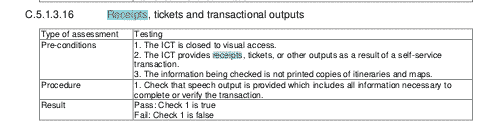
Europe ADA receipt
Comparison of US Standards and European Standards
The short answer
- ADA (and related U.S. regs like 508 / USAB) → prescriptive
- EN 301 549 → descriptive / performance-based
ADA tells you what will get you sued.
EN 301 549 tells you what “accessible” actually means.
Neither, by itself, tells you how to build a kiosk.
Bottom line
- ADA (U.S.) = prescriptive / engineering spec style
- EN 301 549 = functional / outcome-based (descriptive)
- EAA = legal wrapper that points to EN 301 549
Why ADA feels more prescriptive
We used the KMA Code of Practice. It’s full of hard requirements with numbers and physical constraints:
Example
- “Controls shall be operable with one hand…”
- “Activation force shall not exceed 3.0 Newtons”
- “Keys shall be tactilely discernible”
- “Minimum contrast ratio of 3:1”
That’s classic U.S. regulatory DNA:
👉 measurable
👉 testable
👉 enforceable in court
Same pattern exists in ADA 2010:
- Reach ranges (e.g., 15″–48″)
- Clear floor space (30″ x 48″)
- Operable parts (no tight grasping, twisting)
- ATM/audio jack requirements
👉 If you fail one number → you are non-compliant.
Why EN 301 549 feels descriptive
Now contrast that with EN 301 549 (from uploaded 3.2.1 spec):
- “Usage without vision”
- “Usage with limited cognition”
- “Usage without hearing”
- “Functional performance statements”
That’s not telling you how to build it—it’s telling you what outcome must be achieved.
👉 Example mindset:
- ADA: “Button must require ≤ X force”
- EN 301 549: “User must be able to operate without strength limitations”
👉 That’s a big philosophical shift.
What “good” looks like
For a modern kiosk:
1. ADA layer (non-negotiable)
- Reach ranges
- Operable parts
- Physical clearance
- Tactile controls
2. EN 301 549 layer
- Non-visual operation
- No-speech interaction
- Cognitive usability
- Assistive tech compatibility
3. KMA / best practice layer
- Audio navigation model
- Voice interaction
- Multimodal redundancy
- Real deployment constraints (density, population)
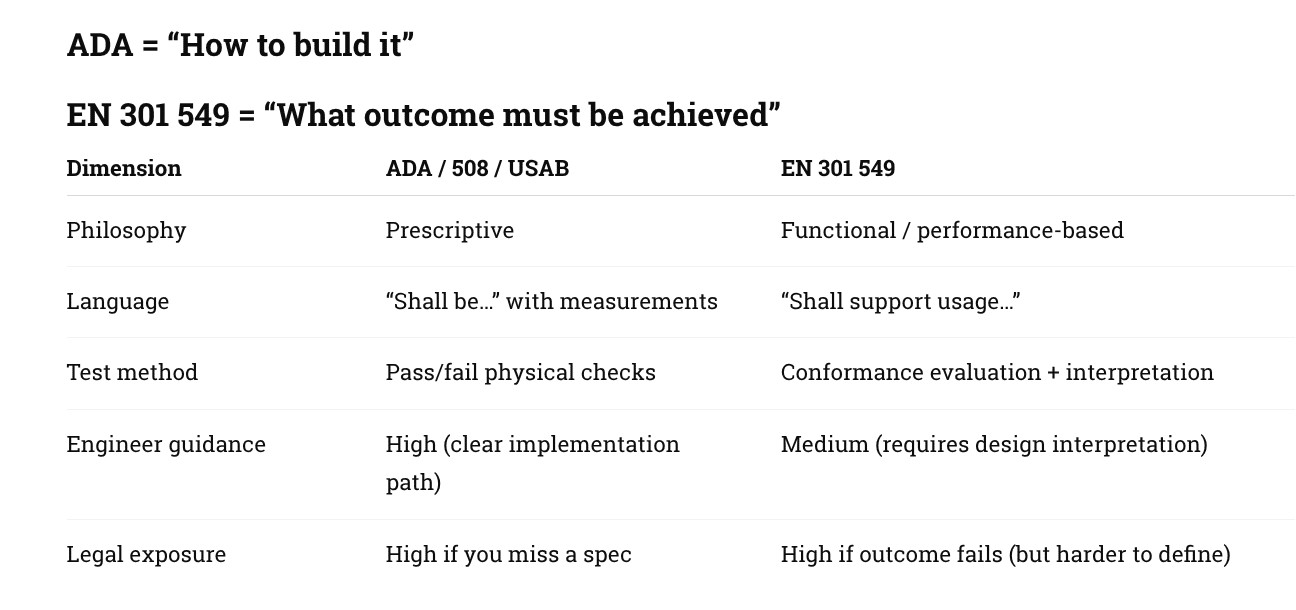
ada en 301 comparison
Additional Related Europe ADA Kiosks Information
- https://kma.global/faq/is-braille-required-for-pos-checkouts/
- https://kma.global/draft-published-web-content-accessibility-guidelines-wcag-2-2/
- https://kma.global/faq/does-wcag-apply-to-or-specified-for-kiosks/
Resources Used
- Latest version of 3.2.1 EN 301 549 provided as pdf above
- European Commission and 301 549
- European Commission and EAA
Separate Content Pages
-
- General Standards
- ADA
- ABA – very important adjunct
- ACA Air Carrier Access
- PCI DSS EMV
- UL
- HIPAA
- Section 508
- AntiBacterial FDA
- Gaming (GLI)
- Cuss and Cute Airlines
- VPAT — Consistent with the original VPAT, version 2.4 provides a column for recording conformance to each provision of a standard or guideline relevant to a product or service. Manufacturers or venders declare the degree of conformance using one of four conformance levels: supports; partially supports; does not support; or not applicable.
FAQ
Question — does EAA provide specific requirements for kiosks and closed systems
Yes, the European Accessibility Act (EAA) does cover kiosks and similar closed systems, but it does so indirectly by product/service type rather than with a “kiosk” chapter by name.
What the EAA explicitly covers
The EAA lists as covered products and services:
-
ATMs, ticketing and check-in machines (these are self-service kiosks in practice).
-
Banking services, transport ticketing/check‑in services, and e‑commerce, which are often delivered via kiosks or other closed ICT systems.
-
Computers, operating systems, smartphones, TV equipment and telecom services, which often integrate with or control kiosk-like terminals.
So if a kiosk is used as an ATM, ticketing, check‑in, banking, transport, or e‑commerce interface, it falls within the scope of EAA-covered products/services, even if the word “kiosk” is not used.
Where the specific technical requirements come from
The EAA itself is a framework directive; it does not spell out detailed hardware/UX specs in its main public summary page.
Instead, the EU uses harmonised standards for the technical detail, and EN 301 549 is the key ICT accessibility standard expected to be used for kiosks and other closed systems (hardware, software, documentation, support).
In practice for kiosks and closed systems in the EU, this usually means:
-
Use the EAA to determine if the product/service type is in scope (e.g., ATM, ticket machine, banking or transport service).
-
Apply EN 301 549 (and related harmonised standards) for concrete requirements: input/output alternatives, tactile/visual feedback, audio, operation without vision/hearing, etc.
Addendum — What About APAC?
1. 🇯🇵 Japan — closest to “EN 301 549 equivalent”
Standard: JIS X 8341
- Multi-part standard:
- Web (Part 3)
- ICT equipment (Part 2)
- Software (Part 4)
- Based heavily on WCAG + ISO/IEC 40500
Why it matters
- Widely adopted in public procurement
- Applies to:
- Ticketing machines
- ATMs
- Public kiosks
- Transport systems
Key characteristic
👉 More structured than EN 301 549 in some areas
👉 Still mixes functional + prescriptive elements
2. 🇰🇷 South Korea — most aggressively enforced in APAC
Framework:
- Act on Promotion of Information and Communications Network Utilization
- KWCAG (Korean WCAG)
Reality:
- Mandatory for:
- Government
- Public institutions
- Large enterprises (in many cases)
Kiosk relevance
- Korea is one of the few countries actively regulating kiosks in practice
- Driven by:
- Banking
- Transit
- Retail self-order kiosks
Key characteristic
👉 More enforcement than Europe in practice
👉 Strong expectation of alternative interaction modes
3. 🇨🇳 China — fast evolving, not fully standardized
Framework:
- GB/T 37668 (Web accessibility)
- Other ICT-related GB/T standards
- Increasing alignment with WCAG
Reality:
- Many standards are recommended (not mandatory)
- Enforcement varies by:
- City (Beijing, Shanghai stronger)
- Sector (government > private)
Kiosk reality (important for you)
China is:
- The largest kiosk / smart terminal market globally
- Deploying:
- Hospital kiosks
- Government service terminals
- Smart lockers
- Retail self-service
👉 BUT:
- Accessibility is often secondary to throughput
- Rapid improvement due to:
- Aging population
- Government “inclusive tech” push
Key characteristic
👉 Market-driven adoption, not compliance-driven (yet)
4. What’s missing in APAC (compared to EU)
| Capability | EU (EN 301 549 + EAA) | APAC |
|---|---|---|
| Unified ICT standard | ✔ | ❌ |
| Legal + technical alignment | ✔ | ❌ |
| Procurement enforcement | ✔ | Partial |
| Kiosk-specific clarity | Medium | Low |
| Functional + physical integration | Medium | Fragmented |
5. Kiosk-specific reality
Across APAC:
What is consistent
- WCAG influence everywhere
- Growing focus on:
- elderly users
- multilingual interfaces
- touch alternatives
What is NOT consistent
- Physical specs (reach, operability like ADA)
- Audio requirements
- Closed functionality handling
- Certification frameworks
👉 Meaning:
No APAC country gives you a complete kiosk standard like a hybrid of ADA + EN 301 549
6. Strategic takeaway
If you are designing kiosks for APAC:
You cannot rely on local standards alone
You need to import discipline from:
- ADA → physical + tactile + operability
- EN 301 549 → functional ICT accessibility
- WCAG → UI layer
7. Blunt industry reality
- Japan = structured, predictable, procurement-driven
- Korea = enforced, aggressive, ahead on kiosks
- China = massive scale, inconsistent accessibility
- Rest of APAC = WCAG-based, web-first, kiosk-light
8. What this means
This is actually a huge opportunity for KMA and TIG:
APAC lacks a unified kiosk accessibility standard