We will be adding to this on ongoing basis but being able to identify and compare self-service devices used in a healthcare application is important. If antibody tests were being dispensed, we’d want to know those test kits were accurate. Same for touchscreen cleaners.
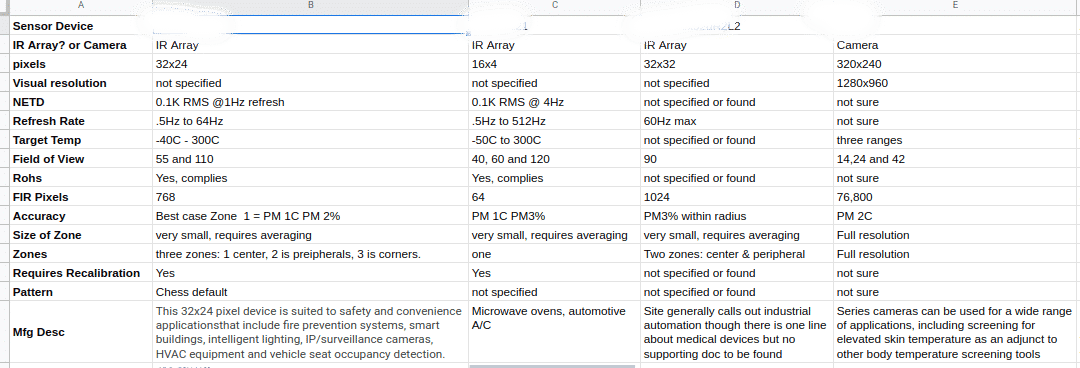
Matrix Comparison
Click for full size
Comparing Temperature Sensor Devices
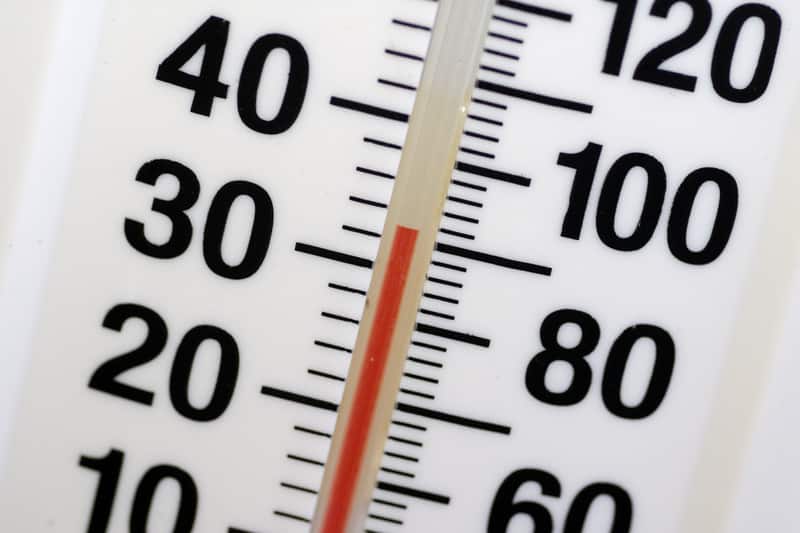
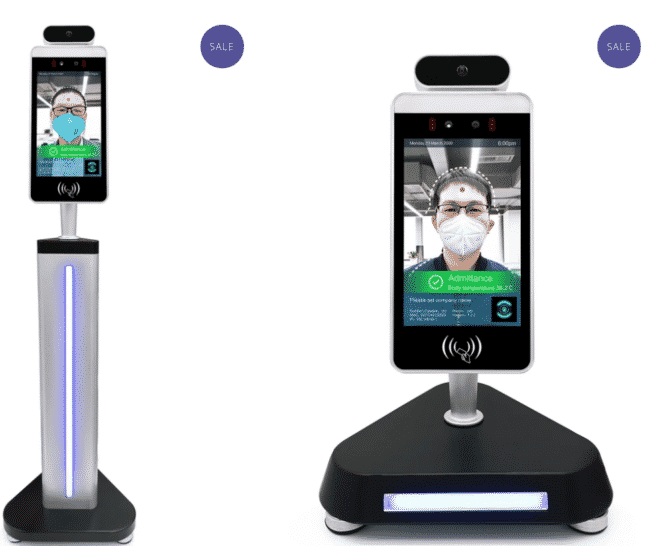
Industrial infrared temperature sensors are inexpensive and used everywhere in home and industrial. Your microwave for example. They read surface temperature if aimed properly and clean and calibrated (all sensors require cleaning and calibration)
The Heimann sensor is the first we encountered. The HPTA32x32 (64 pixel) “thermopile array”.
They have been adapted for reading temperatures of foreheads basically and are at the low end of the accuracy scale.
None of these are FDA approved or submitted.
Thermal Imaging Cameras
These are a whole magnitude higher weight-class. Several of them are specifically designed for supplemental elevated body temperature. They do this by zooming and focusing on specific areas of the face like tearducts. IR Arrays have limited spatial resolution and must average many regions and samples in order to provide a general value.
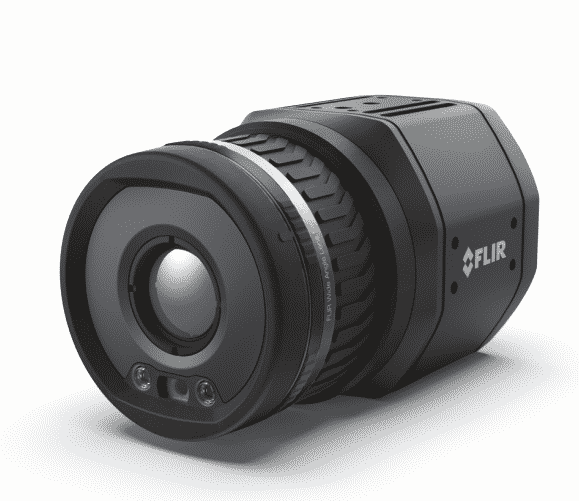
FLIR is the manufacturer most used. They have several which certified by FDA and others submitted.
Another option is ICI though there are some questions on FDA 510 (we cannot locate them) as well as some components used.
Self-Service Kiosk Products for Coronavirus from the KMA
WESTMINSTER, Colo.–(BUSINESS WIRE)–The Kiosk Manufacturer Association announces specific product listings for coronavirus-related self-service assistance. Tailored specifically for coronavirus product offerings are the following:
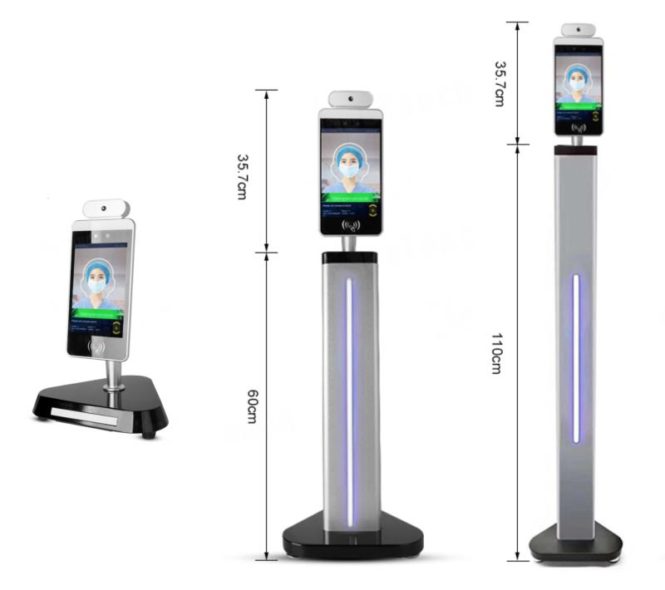
Temperature kiosks for screening and fever detection. Over 20 solutions to choose from and they range from less than a $1000 to more than $25K depending on regulatory approval and accuracy.
Kiosk Software such as Protection As A Service, non-touch touchless software and more.
Touchless Solutions – range from modified IR, foot pedal, gesture, voice-nav and more.
Free and Discounted Covid-related hardware and software solutions. Includes portable digital signage, hand sanitizer kiosks, Sani-holders for sanitizer (designed and used by Panera e.g.).
Cashless – Cash-2-Card self-service kiosks create a frictionless interaction between customer and cashier.
From Craig Keefner, manager of the Kiosk Manufacturer Association, ”Now is the time to provide maximum confidence and access to customers AND employees. Without customers, all the financial subsidies are only a temporary solution, and not a very profitable one. Customers and employees deserve the confidence to return to stores and workplaces. Testing and screening is key to that objective. We can include students, teachers and military personnel for that matter.”
There are many webinars on self-service our members hold. Zebra is holding a series of webinars on Innovating In A Time of Change.
If your company, organization, association, local, city, state or federal agency would like to explore assistance on ADA, EMV or Health, please contact craig@kma.global or call 720-324-1837.
The Kiosk Manufacturer Association recently participated in a temperature kiosk market report conducted by IPVM, one of the premier sources for video surveillance. Video surveillance is not the only market that has pivoted to medical device sales (admitted or not). Kiosk suppliers, hard hit by COVID-19, have also joined this emerging segment.
Inside this report, based on an interview with Craig Keefner, the manager of Kiosk Manufacturer Association (KMA) and editor of Kiosk Industry (KI), IPVMe examines where the kiosk market was before COVID-19 and how kiosk suppliers have rapidly ramped up temperature screening offerings.
As a public service it should be noted that some of the investigative research that IPVM conducted identified one of the main Chinese producers of temperature kiosks and many of the American companies relabelling those products, with widely varying profit margins. You can request a list of those products from the KMA.
Some of the recommended models and manufacturers by the KMA include:
If you would like to participate in the ADA Accessibility working group or the PCI EMV user group please contact craig@kma.global. Issues such as tactile interfaces and audio navigation of POS are some issues that we are currently exploring. Interesting how PCI and ADA can crossover. Members include representatives of the RNIB and the National Federation of the Blind. The KMA is a Participating Organization with the PCI Security Standards Council
Upcoming Webinars
o 08/13 Webinar: Innovating the Warehouse in a Time of Change Thursday, Aug 13, 1:00PM EST Explore how you can leverage new technology to help your operation gain greater levels of visibility through mobile technology, integrated with flexible robotic solutions, all while keeping workers safe.
KMA Products – Tailored specifically for coronavirus product offerings are the following:
Temperature kiosks for screening and fever detection. Over 20 solutions to choose from and they range from less than a $1000 to more than $25K depending on regulatory approval and accuracy.
Kiosk Software such as Protection As A Service, non-touch touchless software and more.
Touchless Solutions – range from modified IR, foot pedal, gesture, voice-nav and more.
Free and Discounted Covid-related hardware and software solutions. Includes portable digital signage, hand sanitizer kiosks, Sani-holders for sanitizer (designed and used by Panera e.g.).
Cashless – Cash-2-Card self-service kiosks create a frictionless interaction between customer and cashier.
If your company, organization, association, local, city, state or federal agency would like to explore assistance on ADA, EMV or Health, please contact craig@kma.global or call 720-324-1837.
Nice writeup by Freedom Scientific on what a screen reader is.
The simple definition is: A screen reader is a software program that allows blind and low vision individuals to read the content on a computer screen with a voice synthesizer or braille display. The screen reader is the interface between the user and the computer operating system and its applications.
The main functions are:
Text-to-speech – the screen reader provides audio output of the screen for the vision impaired
Refreshable braille display — as the screen information changes so does the braille display
Read the full article on Freedom Scientific to learn details and more.
Editors Note – Thanks to our friends at Storm-Interface in the U.K. for forwarding this information.
As explained in the recent press release, the MHRA cautions against over-reliance on temperature screening for detection of COVID-19. Businesses and workplaces are advised to follow the government advice on safe working during COVID-19, as well as implementing scientifically reliable methods of testing for COVID-19 where practicable.
If your company intends to place temperature screening equipment on the UK market then you should be aware that MHRA’s view is that direct claims to screen for fever/febrile illness would bring products within the definition of a medical device, requiring the product to be CE marked and meet the essential requirements of Directive 93/42/EEC (the MDD) before it may be placed on the UK market. Please note that software products may also be classified as medical devices if they fulfil the legal definition. Please read this page for guidance and note that it is the manufacturer’s responsibility to CE mark their products accordingly.
The manufacturer must demonstrate that the device complies with the applicable essential requirements of the MDD (Annex I) and follows an appropriate route to conformity. The requirements for complying with the Directive will vary according to the manufacturer’s intended purpose for the product concerned and its risk classification. All devices have to undergo a conformity assessment procedure and the requirements will vary depending on the risk class.
On the basis of the information provided, MHRA are of the opinion that your thermographic screening module would be a Class IIa device. This means you will have to engage a duly designated notified body to carry out a conformity assessment and issue CE certification before the device may be placed on the market. A flow-chart explaining routes to CE-marking can be found here.
Compliance with relevant harmonised standards may be used as evidence of conformity to the requirements of the MDD. As you have noted, BS EN IEC 860601-2-59:2019 Particular requirements for the basic safety and essential performance of screening thermographs for human febrile temperature screening is likely to be a relevant standard for your device. However, please be aware that certain harmonised standards other than those specific to thermal cameras may also be relevant, e.g. ISO 13485:2016 on Quality Management System requirements.
Please note also that the technical documentation for any medical device must include scientific and clinical data to demonstrate the safety and effectiveness of the device, and manufacturers must hold the data required to substantiate any claims they make about their device. This may require you to perform a clinical investigation to gather sufficient relevant clinical data.
In summary, to comply with the legal requirements, manufacturers wishing to place a medical device on the market in the UK must:
Identify which risk class the device falls into, following the classification rules in Annex IX of the MDD;
Check that the devices meet the relevant essential requirements of Annex I of the MDD;
Undergo a conformity assessment: this will need to be carried out by a Notified Body for all but the lowest risk devices;
Draw up a declaration of conformity and place a CE mark on the device.
You have stated that you wish to sell the temperature screening module business-to-business for your customers to build into their automated kiosk. Your customers would need to be fully aware of the intended use of your module. If they are placing the assembled kiosk on the market, the kiosk supplier should not make any medical claims for the module, or the kiosk as a whole, that would exceed the scope upon which the CE certificate for your module was granted, or which cannot be substantiated by the data held about the device.
Please note that whilst we are willing to give any help and advice we can, any views given by us on the interpretation of the Medical Device Regulations represent our best judgement at the time, based on the information available. Such views are not meant to be a definitive statement of law, which may only be given by the Courts. Accordingly, we would always advise you to seek the views of your own professional advisors.
As lockdown begins to ease, we want to support your staff in helping customers in by offering some simple guidance.
This will not only support your customers with sight loss but help to dramatically improve the overall customer experience.
Helping blind and partially sighted customers
As businesses begin to reopen, providing up-to-date information about any provisions being put in place to protect staff and customers is so important. It is essential to share what physical changes you are making within the store. These changes could include floor indicators, payment zone protective screens, temporary signage, priority opening times and changes to store layouts/one-way systems. Not everyone will be able to see these changes.
Our Best Practice Guidelines
We have created some best practice guidelines to help retail businesses understand how they can help their blind and partially sighted customers with these changes.
We have also created some best practice guidelines to help sport and leisure businesses understand how they can help their blind and partially sighted customers.
From EssentialRetail Aug2020 — Aldi is working with RNIB on improving access for blind and partially-sighted in trial in UK. COVID-related store traffic control is the main system being tested and it helps regulate number of shoppers in the store.
“Social distancing has turned the world upside down for people with sight loss,” said Marc Powell, strategic accessibility lead for RNIB. “Not only has it prevented many people from being guided effectively, but many of the indicators to aid social distancing are visual in nature, making them inaccessible for people who are blind or partially sighted.”
Aldi has announced that it is working with the Royal National Institute of Blind People (RNIB) to help blind and partially-sighted customers safely enter its stores during the Covid-19 crisis.
Aldi is trialling audio prompts at its traffic light entry system to help customers maintain social distancing in stores.
The grocer introduced the traffic light system in May to help safely control the number of shoppers entering and leaving its UK stores. Working alongside its technology supplier, Ocucon, the retailer is trialling the enhanced solution which also uses a series of beeps to let blind and partially-sighted customers know that they can safely enter.
The solution is currently being trialled in Aldi’s Goldthorpe store in South Yorkshire.
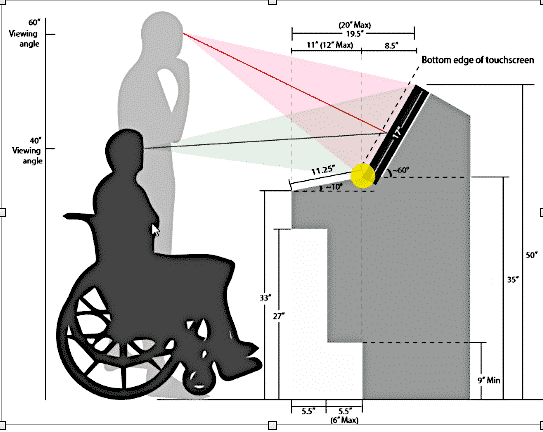
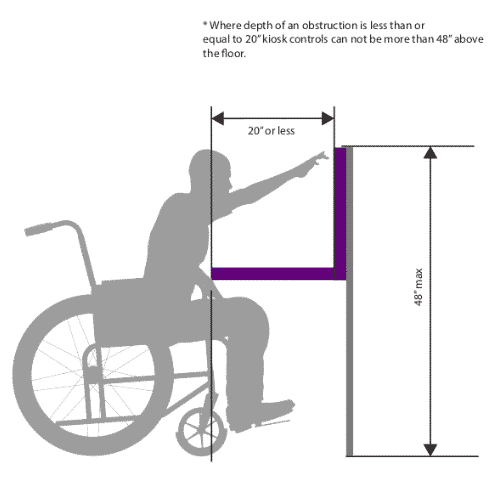
One of 10 or so diagrams of distance and accessibility for wheelchair users. This is the most common structural regulation along with sight and hearing impaired.
Too often when projects requirements are detailed, ADA and accessibility considerations are often reduced to the simple phrase, “Must be ADA compliant”. This statement is open to definition and inevitably results in range of bids with widely different ADA “compliance”“.
Current regulations as stated. These are the currently mandated regulations. These have been reviewed by the U.S. Access Board. One of the main future objectives of the U.S. Access Board is harmonizing the U.S. regulations with the European regulations so there is one worldwide standard. The reference docs for this include:
ADA 2010
Section 508
DOT Air Carrier Access
Other standards to consider: Canadian standards, WCAG, European EN301-549 as well as EMV, state jurisdictional laws and supplemental regulations such as HIPAA, Medical, UL and more.
Code of Practice (Going Forward) – taking the existing standards and restructuring them along with adding in some new technology (voice command e.g.) the KMA developed the Code of Conduct going forward. The intent is to have this ANSI certified and referenced by the U.S. Access Board.
Definitions and Applicability – A note about other standards – certain kiosks may be subject to additional standards. Examples: Airport kiosks must comply with the standards defined by the Air Carrier Access Act. Kiosks procured for federal contracts (or purchased by some municipal and education customers) must comply with the Revised Section 508 Standards. ATMs 2010 ADA, etc.
Functional Performance Criteria
302.1 thru 302.9
Installation & Environment
Clear Floor or Ground Space
Closed Functionality
Biometrics
Privacy
Standard Connections
Operable Parts
407 Operable Parts
408 Display Screens
409 Status Indicators
410 Color Coding
411 Audible Signals
Software
General (501)
Interoperability with Assistive (502)
Captions 1.2.2
Audio Description 1.2.3
Contrast 1.4.3
Low Audio 1.4.7
No Background
Focus Order
Focus Visible
Pointer Cancellation
Target Size
On Focus
Error Identification
Labels or Instructions
Tactility, Voice Recognition and Speech Command
Visual Display Screens
Tactilely Discernible Controls.
Alphabetic keys
Numeric Keys
Audible Output
Voice Recognition and Speech Command
Recommendations for distribution
It is recommended that only ‘accessible’ kiosks be installed until 25% of the total kiosk population in any given location, grouping, common purpose or application meet Standards for Accessible Design
This minimum kiosk population density applies to owned, jointly owned, leased, shared use, controlled, franchised or operated kiosks or other ICT terminals deployed in public spaces, public amenities and in places of public accommodation or service.
To comply with the ACAA Standards for Accessible Design only ‘accessible’ kiosks should be installed until 25% of the kiosk population meets the requirements for Accessible Design.
To comply with the ACAA, 25% of the kiosk population, located together for a common purpose(s), in a group, line or other configuration, must be compliant by December 12th 2022
Acknowledgments –
Contributing KMA sponsors – Olea Kiosks, KioWare, Nanonation, Pyramid, Frank Mayer, Vispero, ZIVELO, KIOSK Information Systems, DynaTouch, TurnKey Kiosks, 22 Miles, Peerless AV, Parabit Systems, Qwick Media, LG-MRI, Lexmark, Intel Corporation, AudioEye, PROVISIO, Kiosk Group, OptConnect, CSA Self-Service, Storm Interface, Tech For All, Mimo Monitors, UCP Unattended Payments, OTI Global and Evoke.
Additional Consulted – IMPRESA, TouchPay, Acquire Digital, Self Service Networks, Panel Brite, TTCE, SEKO MedTec, Marathon, CUSTOM, TOKENWORKS, Insight Touch, Microcom, TECA, STEGO, Practical Automation, Ingenico, Esper. IO, Axiohm, TDS TOUCH, Evolis, BOCA Systems, URway Holdings, Alveni, Kiosk Innovations and Apriva. We also recognize multiple retailers, the RNIB (via proxy), NCR Dundee and the University of Maryland for their contributions.
Westminster, CO September 2020 — The kiosk association (KMA) is proud to announce the first multi-vendor kiosk solution catalog for COVID-related kiosk “worker” solutions. Over twenty different solutions related to COVID and Temperature are available for purchase. CAKCEK, our authorized distributor, has been actively bidding this catalog of solutions in various RFPs in the SLED and Federal markets. Put qualified technology to work for you.
Compliance Issues
Temperature kiosks come with a Certificate of Compliance regarding sensor accuracy. They are designed and manufactured by members which meet the KMA ADA conformance requirements in ADA, Accessibility, FDA, and PCI to name some of the relevant regulatory issues. Kiosks solutions manufactured primarily in the US are available. Members from the UK and Germany with offices in the U.S. also are available.
CAKCEK has been established as the authorized distributor for KMA conformance solutions. The owner of CAKCEK, Craig Keefner says, “We’ve been monitoring the temperature and thermal imaging market closely. The proliferation of Chinese-origin devices with undisclosed components both software and hardware into this market has been disconcerting at best. Almost all of those units come with facial recognition, artificial intelligence, and a general inattention to regulatory and legal issues. This raises serious liability issues, especially for healthcare-oriented deployments, down the road as well as the general health concerns of false positives. By offering a catalog of KMA approved choices our first priority is to inform and educate buyers in the marketplace.”
Kiosk “Workers” Available
Temperature Scanning Kiosks
Low pixel count entry-level with medical-grade sensors
Medium pixel count mid-level systems
High-end thermal imaging systems which are FDA-certified
Systems include quantity pricing and Lease options
Repurposing options provided
Digital signage options provided
Smart City kiosk options
Countertop, Stand-up, Sit-down and Wall-Mount configurations
Microsoft Surface Tablet Options
iPad options
CDC Screening Stations
CDC Recommended Health Screening kiosk options
Sanitizer Kiosks
Heavy duty cycle sanitizer dispense systems
Standup systems
Countertop systems
Standup system including digital signage
Software Only Solutions
NoTouch Touchless Software (Android and Windows)
Digital signage options (some portable and outdoors)
Secure lockdown software KioWare, Sitekiosk and Esper are available for purchase
JAWS accessibility software for Windows is available
Warranty and Service
Standard one year warranty on all systems
Sanitizer kiosks come with 2-year warranty
All original manuals are in English. Chinese not available.
Germany and UK units are also available though we expect those will soon have manufacturing in the US
FAQ Questions
Our brochure includes a set of 23 questions that you should be asking before any purchase. Examples include:
Many Chinese kiosks facial recognition use blacklisted Chinese tech firms. This is a distinct liability for deployers in health care industry.
Chinese-made relabeled units are marked up anywhere from 100% to 600% and can be reviewed at Alibaba.
Have you read the FDA enforcement letter and understand it? We have a FAQ. It appears that the window of forgiveness is starting to contract introducing liabilities
We recommend opinion post on Chinese software for more background.
Security Issues
Most of the Chinese-origin units employ facial recognition in concert with inexpensive thermopile temperature sensor. The technology employs algorithms and server connections from blacklisted Chinese tech firms such as Dahua and HKVision. This brings privacy concerns to the forefront.
How To Purchase
Your first option is for CAKCEK to connect you with the partner product you wish to purchase. You arrange the purchase directly with them.
You purchase from CAKCEK. We process the order and manage it for you.
If desired you can purchase direct from the partner but CAKCEK will remain involved as a point of coordination.
Contact Us
You can email Craig@catareno.com for more info or complete the form here indicating your interest. We offer primarily to the SLED and Federal market for now.


 Editors Note – Thanks to our friends at