
Access Currents
 News from the U.S. Access Board • March/ April 2019
- Access Board to Hold Town Hall Meeting and Training in Indianapolis on May 21
- Karen Tamley Elected Access Board Chair
- Upcoming Board Webinars
- Poland Creates Entity Modeled after the U.S. Access Board
- Congressional Measures Address Airline Accessibility
- Guidelines for Voting Systems Available for Public Comment
- Updated VPAT Now Available from the IT Industry Couil
Access Board to Hold Town Hall Meeting and Training in Indianapolis on May 21
 The Access Board will hold a town hall meeting in Indianapolis on the afternoon of May 21 at Bankers Life Fieldhouse. The event will provide an open forum where members of the public can pose questions to the Board or share comments or concerns about accessibility for people with disabilities. There also will be panel discussions with area speakers on accessible recreation and outdoor environments, the Indiana AgrAbility Project, and local compliance initiatives under the Americans with Disabilities Act (ADA).
The event will take place in the Pacers Square Room at Bankers Life Fieldhouse from 2:00 pm to 4:30 pm. Registration is not required. An assistive listening system, computer assisted real-time transcription (CART), and sign language interpreters will be available. Attendees are requested to refrain from using perfume, cologne, and other fragrances for the comfort of all participants. The meeting will not be streamed online, but there will be a call-in option and streaming CART.
Earlier in the day, the Board will also offer free training sessions on the ADA Accessibility Standards at the town hall site. There will be a program on how to apply the standards and common sources of confusion (9:00 am – 10:30 am). This will be followed by a session on recreation facilities and outdoor sites (10:45 am – 12:15 pm). Advance registration is not required, and participants can attend either or both sessions. Qualified attendees can earn continuing education credits (1.5 per session) from the American Institute of Architects.
For further information, contact Dave Yanchulis at yanchulis@access-board.gov, (202) 272–0026 (v), or (202) 272–0027 (TTY).
U.S. Access Board Training and Town Hall Meeting, May 21
Pacers Square at Bankers Life Fieldhouse
125 S. Pennsylvania Street, Indianapolis, INTraining Session on the ADA Accessibility Standards (free)
• 8:00 – 9:00 Registration & Welcome
• 9:00 – 10:30 Application of the Standards & Common Sources of Confusion
• 10:30 – 10:45 Break
• 10:45 – 12:15 Recreation Facilities & Outdoor SitesTown Hall Meeting
• 2:00 – 2:15 Opening Remarks
• 2:15 – 3:30 Panel Discussions
• 3:30 – 4:30 Overview of the Access Board & Open Forum
 U.S. Access Board Training and Town Hall Meeting, May 21
 Karen Tamley Elected Access Board Chair
 At its March meeting, the Board unanimously elected Board Member Karen Tamley as its new Chair. Tamley just completed a term as Vice Chair of the Board and has served as the Commissioner of the Chicago Mayor’s Office for People with Disabilities since 2005.
“I am honored to serve as the Chair of such a dedicated agency that is a true force for change and that has done so much to advance accessibility both in the U.S. and abroad,” she stated after the vote. “I look forward to working with Board members and staff in the year ahead.”
Tamley joined the Board in 2015 as a public member. As head of the Mayor’s Office for People with Disabilities, she leads numerous disability policy and compliance initiatives in transportation, city infrastructure, emergency preparedness, housing, schools and technology, and other areas. She also oversees the delivery of independent living services to city residents.
She succeeds Lance Robertson who represents the U.S. Department of Health and Human Services (HHS) on the Board and who was named Vice Chair by acclamation. He serves as Assistant Secretary for Aging at HHS and heads its Administration for Community Living and previously was Director of Aging Services at the Oklahoma Department of Human Services.
Board officers serve for a term of one year. The Board is structured to function as a coordinating body among Federal agencies and to directly represent the public, particularly people with disabilities. Half of its members are representatives from most of the Federal departments. The other half is comprised of members of the public appointed by the President.
 Ensuring that public streets and sidewalks are accessible to people with disabilities can be a challenge, especially since accessibility guidelines for public rights-of-way have yet to be finalized. The next webinar in the Board’s free monthly series will take place June 6 from 2:30 – 4:00 (ET) and will be devoted to answering the various questions that come up in addressing access to sidewalks and street crossings, pedestrian signals, on-street parking, roundabouts, transit stops and other components of public rights-of-way as well as shared use paths. Board Accessibility Specialists will answer questions submitted in advance or during the live webinar and offer guidance, solutions, and best practices based on guidelines the Board proposed for public rights-of-way. Attendees are encouraged to submit their questions in advance.
Visit www.accessibilityonline.org for more information or to register for the webinar. Webinar attendees can earn continuing education credits. The webinar series is hosted by the ADA National Network in cooperation with the Board. Archived copies of previous Board webinars are available on the site.
Section 508 Best Practices Webinar
The Board also offers a free webinar series on its Section 508 Standards for ICT in the federal sector. The next webinar in this series will be held May 28 from 1:00 to 2:30 (ET) and will review the Trusted Tester for Web and highlight significant updates. Developed by Department of Homeland Security’s (DHS) Office of Accessible Systems and Technology in coordination with other agencies, the Trusted Tester Process provides a scalable, repeatable, accurate process for evaluating web and software products for conformance with the 508 Standards.
Representatives from the Board and DHS will review the latest edition (Version 5) which supports the revised Section 508 Standards and the Web Content Accessibility Guidelines (2.0). Trusted Tester 5.0 improves the format, flow, and construction of the evaluation process and test conditions. Presenters will discuss the new testing tool, the Accessible Name and Description Inspector (ANDI), and how it aids testers with code inspection-based testing. They will also cover the availability of DHS online training and certification. Questions can be submitted in advance of the session or can be posed during the webinar.
Visit the webinar site for further information or to register. The Section 508 Best Practices Webinar Series is made available by the Accessibility Community of Practice of the CIO Council in partnership with the Board. Prior webinars can be accessed on the site.
Poland Creates Entity Modeled after the U.S. Access Board
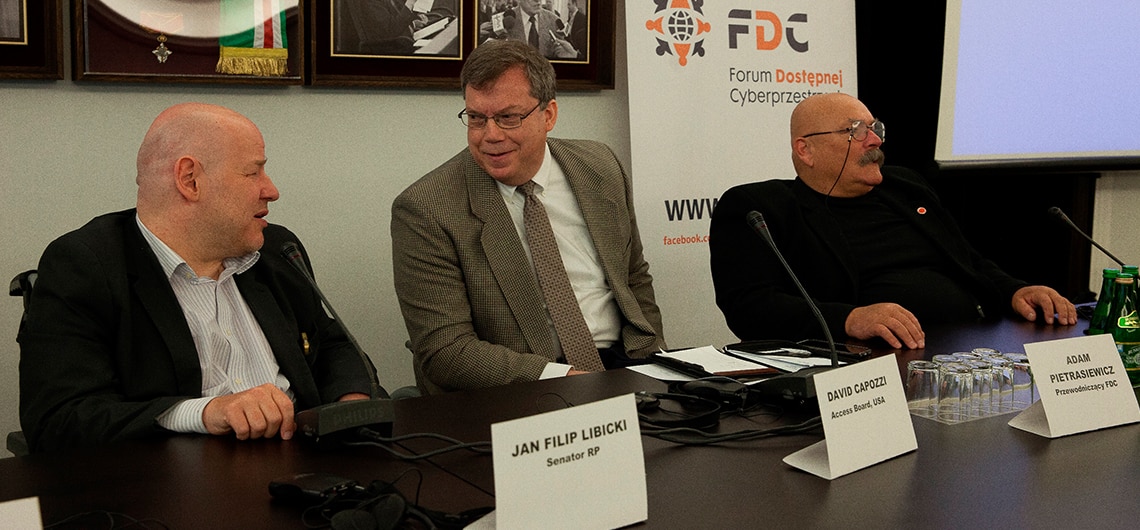
 The Polish government has established an agency to promote accessibility that is modeled after the U.S. Access Board. Created in December, the Accessibility Council is responsible for reviewing laws and regulations and making recommendations to the government on implementing a sweeping new law to advance accessibility nationwide. The Council is comprised of 50 members representing ministries and government bodies, disability groups, and academia and meets quarterly. The Council will play a lead role in implementing the Accessibility Plus Program, an new measure that aims to make Poland a leader in accessibility by eliminating barriers in architecture, transportation, education, health care, digital and other services.
Poland’s Minister of Investment and Development Jerzy Kwieciński, who heads the Accessibility Council, credits the work of the U.S. Access Board and a speaking tour by Board Executive Director David Capozzi as the inspiration for the new entity. At the Council’s inaugural meeting in February, he recognized the Access Board’s influence and stated, “I believe that now Poland will become a model for other countries.” He supports a study tour of the U.S. for Council staff, including further consultations with the Board.
Capozzi travelled throughout Poland in 2017 as part of State Department’s speaker program to share the American experience in ensuring accessibility for people with various disabilities. During his weeklong stay in Warsaw, Gdynia, Gdańsk, and Kraków, he met with national and local authorities, advocacy groups, and other representatives, some of whom were instrumental in creating the Council. Capozzi discussed achievements and challenges of ensuring accessibility in the U.S. and shared lessons learned. He participated in dialogues on different aspects of accessibility, including the built environment, information and communication technology, employment, enforcement, and the important role standards play, among other topics.
“It was an honor to travel to Poland on behalf of the State Department and our embassy to meet with those leading the effort to make the country a model for accessibility,” states Capozzi. “The Board looks forward to learning more about their efforts and achievements and exploring how we can further advance accessibility in both our countries.”
David Capozzi in Poland
Congressional Measures Address Airline Accessibility
 Legislation was recently introduced in Congress to supplement the Air Carrier Access Act (ACAA) which prohibits discrimination in air transportation. Congressman Jim Langevin (D-RI) and Senator Tammy Baldwin (D-WI) submitted bills in the House (H. R. 1549) and Senate (S. 669) to amend the ACAA to further improve access at airports and on aircraft. The bills would create accessibility standards for new airplanes, require removal of barriers on existing airplanes where readily achievable, strengthen enforcement mechanisms, including establishment of a private right of action and enhance safety.
Under these measures, the Access Board would be responsible for issuing standards for aircraft and equipment for boarding and deplaning, including seating accommodations, lavatories, stowage of assistive devices, announcements, and in-flight entertainment and video displays. The standards also would address airports, including ticketing counters, gates, customer service desks, audible announcements, kiosks, and websites. The bills were referred to the appropriate House and Senate committees for consideration.
In addition, under a law passed last year, the Department of Transportation (DOT) began reporting data on the number of passenger wheelchairs and scooters that are damaged or mishandled by airlines on a monthly basis. A total of 701 (2.18%) wheelchairs and scooters were damaged last December, an average of more than 25 a day, as reported in DOT’s monthly Air Travel Consumer Report (February issue). The total for January was 681 (2.06%) and for February was 593 (1.7%).
In a statement, Senator Tammy Duckworth (D-IL), who authored the law said, “Every airline passenger deserves to be treated with dignity and respect, but too often they aren’t. Travelers should be able to find out if certain airlines have high rates of breaking wheelchairs and other equipment that people depend on, just like we can find out if certain airlines have high rates of flight delays or cancellations.”
Further information on this reporting is posted on DOT’s website.
Guidelines for Voting Systems Available for Public Comment
 Federal guidelines for voting systems implemented under the Help America Vote Act are currently available for public comment. Issued by the U.S. Election Assistance Commission (EAC), the Voluntary Voting System Guidelines (VVSG) provide principles and criteria for assessing the basic functionality, accessibility, and security of voting equipment.
The EAC released the document, referred to as VVSG 2.0, on February 28 for a 90-day comment period, as indicated in a notice published in the Federal Register. The VVSG 2.0 updates guidelines first issued in 2005 and revised in 2015 and features a new streamlined structure comprised of high-level system design goals with broad descriptions of the functions that make up voting systems. The proposal also includes moving technical requirements and test assertions to separate documents that detail how voting systems can meet the new Principles and Guidelines in order to obtain certification. Those requirements and test assertions will be made available for public comment at a later date. The EAC seeks comments on all sections of the Principles and Guidelines including the proposed restructuring. Comments are due May 29.
For further information, visit the EAC’s website or contact Ryan Macias at (301) 563-3931 or votingsystemguidelines@eac.gov
Updated VPAT Now Available from the IT Industry Council
 The Information Technology Industry Council (ITI) maintains a free reporting tool known as the Voluntary Product Accessibility Template (VPAT) to help determine whether information and communication technology products and services satisfy accessibility requirements, including the Section 508 Standards. ITI recently released revised editions of the VPAT (2.3) based on the Board’s revised 508 Standards (VPAT 2.3 508), including the referenced Web Content Accessibility Guidelines (WCAG 2.0). It also offers VPATs for WCAG 2.1 (VPAT 2.3 WCAG), the European Union’s ICT requirements (VPAT 2.3 EU), and another based on all three (VPAT 2.3 INT).
Visit the ITI’s website for further information or send a message to info@itic.org.