Analysis – DOJ Accessibility Guidance on Web March 2022

website accessibility DOJ

DOJ Accessibility Guidance Analysis

From Understanding the ADA Blog by William Goren. Mr. Goren is a very highly respected authority on accessibility.  We also have the point of view from AccessDefense.  Additional viewpoints.

In Brief (by Bill Goren)

  • Document is too general in view of Goren
  • Maybe the FCC is watching in regard to mobile phones?
  • WCAG 2.1 recommended for now
  • Voice dictation mentioned which is great
  • The guidance seems to encourage overlays

Excerpt

  1. Common examples of website accessibility barriers include: poor color contrast; use of color alone to give information; lack of text alternatives on images; lack of captioning on video; inaccessible online forms; and mouse only navigation. This list is not exclusive.
  2. Many state and local governmental services, program, and activities are now being offered on the web. Since a website with inaccessible features limits the ability of people with disabilities to access a public entity’s program, services, and activities through that website, the DOJ has consistently taken the position that the ADA’s requirements apply to all the services, program, or activities of state and local governments, including those offered on the web.
  3. A website with inaccessible features can limit the ability of people with disabilities to access a public accommodation’s goods, services, and privileges available through that website. Accordingly, DOJ has consistently taken the position that the ADA’s requirements apply to all the goods, services, privileges, or activities offered by public accommodations, including those offered on the web.
  4. Automated accessibility checkers and overlays identifying or fixing problems with a website can be helpful tools, but they need to be used carefully.
  5. Businesses and state and local governments have flexibility in how they comply with the ADA’s general requirements of nondiscrimination and effective communication. But they must comply with the ADA’s requirements.
  6. The Department of Justice does not have a regulation setting out detailed standards for Internet accessibility, but the Department’s longstanding interpretation of the general nondiscrimination and effective communication provisions applies to web accessibility.
  7. Businesses and state and local governments can currently choose how they will ensure that the programs, services, and goods they provide online are accessible to people with disabilities. Even though businesses and state and local governments have flexibility in how they comply with the ADA’s general requirements of nondiscrimination and effective communication, they still must ensure that the programs, services, and goods that they provide to the public—including those provided online—are accessible to people with disabilities.
  8. Existing technical standards provide helpful guidance concerning how to ensure accessibility of website features. These include the Web Content Accessibility Guidelines (WCAG)and the Section 508 Standards, which the federal government uses for its own websites.

In the “Takeaways” section Bill lists nine different takeaways he sees. We liked the note on voice dictation which hasn’t been mentioned before.

Best to read the complete article From Understanding the ADA Blog by William Goren


For a most defense oriented point of view here is Access Defense

The Guidance starts with a broken promise:

This guidance describes how state and local governments and businesses open to the public can make sure that their websites are accessible to people with disabilities as required by the Americans with Disabilities Act (ADA).

It does no such thing. Instead it points out a few common problems and lists resources that might be helpful to experts in web development. Nowhere does it provide any set of actions or website features that are guaranteed to satisfy the ADA. In fact, it doesn’t even state clearly what DOJ has said in the past; that is, that every website is subject to the ADA even if not associated with a physical place of business. Here is how DOJ states its position:

Title III prohibits discrimination against people with disabilities by businesses open to the public (also referred to as “public accommodations” under the ADA). The ADA requires that businesses open to the public provide full and equal enjoyment of their goods, services, facilities, privileges, advantages, or accommodations to people with disabilities.

DOJ apparently wants “businesses open to the public” to means the same thing as “public accommodation,” but the Ninth and other Circuits disagree that the phrases are equivalent. The same ambiguous use of “public accommodation” and “open to the public” occurs throughout the Guidance, although it isn’t clear why DOJ won’t just come out and say that it believes every website is a public accommodation no matter what any Circuit Court of Appeals might say.

The actual guidance about website accessibility is a mishmash of qualified statements that end up saying almost nothing. For example, DOJ asserts that:

Businesses and state and local governments can currently choose how they will ensure that the programs, services, and goods they provide online are accessible to people with disabilities.

This is true as a very broad statement of the law, but it doesn’t remind businesses that almost any means of providing online services other than an accessible website will be viewed by DOJ as insufficiently equal. Can DOJ just say what it means? There is a choice in theory, but in fact if services are provided online DOJ will insist that they be accessible online regardless of the other means by which the services are offered.

DOJ seems to be a little more specific when lists seven common problems with accessibility, but then it reminds us this is not a complete list: “This is not a complete list of things to consider.” Where can a business find a “complete list?” DOJ lists a bunch of resources, including the W3 consortium website for the Web Content Accessibility Guidelines, but all it says about these is “existing technical standards provide helpful guidance.” Businesses do not need helpful guidance; they need rules so they know they will not be subject to arbitrary prosecutions or private litigation. Those with disabilities need the same thing so they know what to expect with any given website. It’s nice to know that WCAG 2.1 AA is out there, and a look at other DOJ press releases indicates that WCAG 2.1 AA is the best guess for what DOJ wants today. However, there is no telling what DOJ will want tomorrow, and private plaintiffs’ firms and some courts don’t treat any version or success level of WCAG as sufficient.³

What if you want to know whether your website is accessible? DOJ points out what experts in the area know; that is,  automated solutions are unlikely to identify or solve all problems and do identify “errors” that don’t interfere with accessibility. You can’t rely on them, but DOJ’s suggestion about dealing with that unreliability isn’t very comforting: “Pairing a manual check of a website with the use of automated checkers can give you a better sense of the accessibility of your website” While it is certainly nice to have a “better sense” of the accessibility of a website businesses need something definite – yes it is or no it is not accessible. They need an exact definition of accessibility so they know what to do in order to be exempt from litigation by DOJ and private plaintiffs.¹

It’s worth something to know you’re going to be hit by a train even if no one will tell you how to get off the track² so this Guidance isn’t completely useless. Nonetheless, it fails to deliver what businesses need. They needs  fixed safe harbor definition of an accessible website, and they need relief from abusive website accessibility litigation. Moreover, by failing businesses the Guidance fails those with disabilities as well because businesses cannot be expected to invest in technology if they can’t be sure it will bring them into compliance with the law. DOJ needs to spend less time on press releases and more time on fulfilling its regulatory obligations under the ADA.

+++++++++++++++++++++

¹ Imagine if DOJ’s advice on the slopes of sidewalks was “using a high quality digital level will give you a better sense of the accessibility of your sidewalk.” As advice it is useless – businesses what to know what the maximum accessible slope is, not how you measure it.

² The resources offered in the Guidance are worthless to most small businesses because they are simply too technical. The first link offered, to the 18F Accessibility Guide, takes you to a cover page to a total of 26 other websites that have accessibility information, including another “tools” link that provides links to an additional 22 testing tools. None of the links go to material that anyone but an expert in website development could possibly understand. This is great for a business large enough to have an IT team and budget, but those businesses already know where to look for resources. This Guidance is useless for any business that doesn’t generate sufficient profits to pay for a dedicated IT staff.

³ I think it is interesting that the government has promulgated specific rules for accessibility of government websites, as DOJ admits, but DOJ won’t give businesses the benefit of the exact same rules. Is it bureaucratic arrogance? Some kind of power struggle between DOJ and the Access Board? Who knows. There are plenty of hardworking nice folks at DOJ, but as an institution it apparently doesn’t give a damn about the real problems of real businesses even though DOJ itself created those problems when it decreed, twenty years ago, that websites have to be accessible but then refused, and refuses even to this day, to say what “accessible” means.


DOJ Breaks Its Silence – Jackson Lewis

The most important takeaway from the Guidance is the fact that the DOJ has issued Guidance at all on this topic.  Indeed, on December 26, 2016, the DOJ Published a Notice of Withdrawal of Four Previously Announced Rulemaking Actions.  See 82 Fed. Reg. 60932 (December 26, 2017).  After years of silence on the issue of Title III of the ADA’s application to websites, the fact that the DOJ has turned its attention to this topic may indicate increased enforcement activity by the DOJ than in years past.


Open To Public Means Must Be Accessible – Ballard Spahr

The DOJ specifically noted that in recent years, “a multitude of services have moved online, and people rely on websites like never before for all aspects of living,” including accessing voting information, finding up-to-date health and safety resources, and looking up mass transit schedules and fare information. The DOJ’s Guidance clarified that the Department has “consistently taken the position that the ADA’s requirements apply to all the goods, services, privileges, or activities offered by public accommodations, including those offered on the web.”


Related Posts
U.S. Access Board News – Alison Levy New Director

US Access Board ADA voting

ADA Kiosk & U.S. Access Board News

Access Board Alison Levy” src=”https://kma.global/wp-content/uploads/2022/06/alison-levy.png” alt=”U.S. Access Board Alison Levy” width=”153″ height=”201″ /> U.S. Access Board Alison Levy

Alison Levy has been named the new Director of the Office of Technical and Information Services (OTIS) at the U.S. Access Board. She succeeds Dave Yanchulis who retired in April after 36 years with the Board. In this role, Levy will manage and establish program goals and operations for OTIS, including those related to accessibility guidelines and standards, technical assistance and guidance, training, and research. OTIS is responsible for the development of the Americans with Disabilities (ADA) and Architectural Barriers Act (ABA) Accessibility Guidelines for buildings, facilities, and transportation vehicles, Standards and Guidelines for Accessible Information and Communication Technology, and Standards for Accessible Medical Diagnostic Equipment.

“I am excited to have Alison join our team of dedicated experts in the accessibility space.” Board Executive Director Sachin Pavithran said. “She will be leading a team of experts that plays a vital role in advancing our accessibility standards and guidelines in advancing equal access for all.”

Full Text

Alison Levy has been named the new Director of the Office of Technical and Information Services (OTIS) at the U.S. Access Board. She succeeds Dave Yanchulis who retired in April after 36 years with the Board. In this role, Levy will manage and establish program goals and operations for OTIS, including those related to accessibility guidelines and standards, technical assistance and guidance, training, and research. OTIS is responsible for the development of the Americans with Disabilities (ADA) Accessibility Guidelines and Architectural Barriers Act (ABA) Accessibility Standards, standards and guidelines for accessible information and communication technology, and standards for accessible medical diagnostic equipment.

“I am excited to have Alison join our team of dedicated experts in the accessibility space.” Board Executive Director Sachin Pavithran said. “She will be leading a team of experts that plays a vital role in advancing our accessibility standards and guidelines and advancing equal access for all.”

Levy most recently served as the Manager of the U.S. Department of Transportation’s Disability Resource Center (DRC). The DRC is a centrally funded office that supports internal supervisors and employees in creating an accessible and inclusive workplace through recruitment, hiring, outreach, education, and reasonable accommodations.

“Accessibility is a human right that ensures we all thrive together in society,” Levy remarked. “I look forward to working at the Access Board in broadening its capacity to better educate and obtain greater access for all.”

Previously, Levy served at the U.S. Department of Agriculture (USDA), providing leadership over the recruitment, hiring, advancement, and retention of individuals with disabilities, including reasonable accommodations. She developed and implemented policies, procedures, and strategic plans, and facilitated programs through a diverse team of more than 50 contacts across USDA’s 34 mission areas, agencies, and staff offices. Her efforts with a team of diversity and inclusion colleagues yielded USDA’s six-level rise in the Federal Employee Viewpoint Survey to #2 for Large Federal Agencies in Diversity Support.

Levy was one of the founding leaders of the Federal Disability Workforce Consortium (FDWC), a volunteer, interagency organization that grew from 20 to more than 900 federal points of contact with monthly webinars, meetings, and collaborations with the Office of Personnel Management, Equal Employment Opportunity Commission, and the Department of Labor’s Office of Disability Employment Policy.

As a person with disabilities, and with over 30 years of experience in the disability profession, Levy has worked toward improving workplace attitudes and accessibility, and in providing equal opportunity in the post-secondary, public, and private sectors. Levy earned her B.A. in Public Communication from The American University and her Master’s in Special Education from Johns Hopkins University. She is fluent in American Sign Language.

More Posts

Website Accessibility – Intro By U.S. Access Board + Tips

An Introduction to Website Accessibility

We sat in on the Thursday, May 5, 2022 Session. Bruce Bailey of U.S. Access Board led the discussion and as usual provided the “kitchen sink” when it comes to website accessibility. Below are the materials from that session.

We have also included our personal tips for testing and providing website accessibility. We recommend getting on the mailing list for U.S. Access Board and continuing your education and learning regarding accessibility.

Description

Everyone needs access to digital information provided by the World Wide Web. However, many websites have subtle barriers that prevent people with disabilities from using content. Fortunately, accessibility is not difficult to implement, and most accessibility features do not require significant changes to the visual presentation. This session will review what web accessibility is, how people with disabilities use the web, how to quickly identify accessibility barriers, and what are some simple solutions. Access Board IT Specialist Bruce Bailey will also clarify common sources of confusion about web accessibility and provide key resources for learning more about website accessibility. Questions can be submitted in advance of the session or can be posed during the live webinar. This webinar will include video remote interpreting (VRI) and real-time captioning. Webinar attendees can earn continuing education credits.


Multimedia Archives

Playback Video
Note: No credit is available for reviewing the recorded session.
Power Point   PowerPoint-Website Accessibility 5-5-2022 (Power Point File)
PDF   Handout Web Accessibility 5-5-2022 2slides perpage (PDF File)
RTF   Handout Web Accessibility 5-5-2022 RTF (RTF File)

Speakers

Bruce Bailey IT Specialist, U.S. Access Board


Useful Tips for Testing, Implementing and Providing Website Accessibility

  • “Magic bullet” plugins for Wordpress and other CMS web systems — Generally these are “accessibility theater”.  We have tested and tried many of these. It’s important to note that when we say “tested” we mean we have had disabled users of different tenors actually try the website and let us know what passed and what failed.
  • Generally tab stops, alt text for images, a readable base font of 16 (1 em is rule) and sufficient contrast ratios for text and hyperlinks is a good place to start’
  • Videos are becoming more commonplace. Accurate and understandable captions are required. Transcripts are nice for dialogue but they do not mitigate lack of captions in the actual video.  There are a variety of transcription services.
  • Running Wordpress ourselves, we have considered activating plugin such as WAH Accessibility Pro.  It provides some nice control of text, zoom and even audio.  As a plugin it has a relatively light footprint when it comes to load factor.  A WP site with Google dev speed of 99 (e.g. kma.global) will drop to around 85 with the plugin fully configured.  You can mitigate load factor by utilizing CDN like Cloudflare (highly recommended). That should bring it back to around 95.
  • Checking your site
    • WCAG 2.1 Level AA is base reference
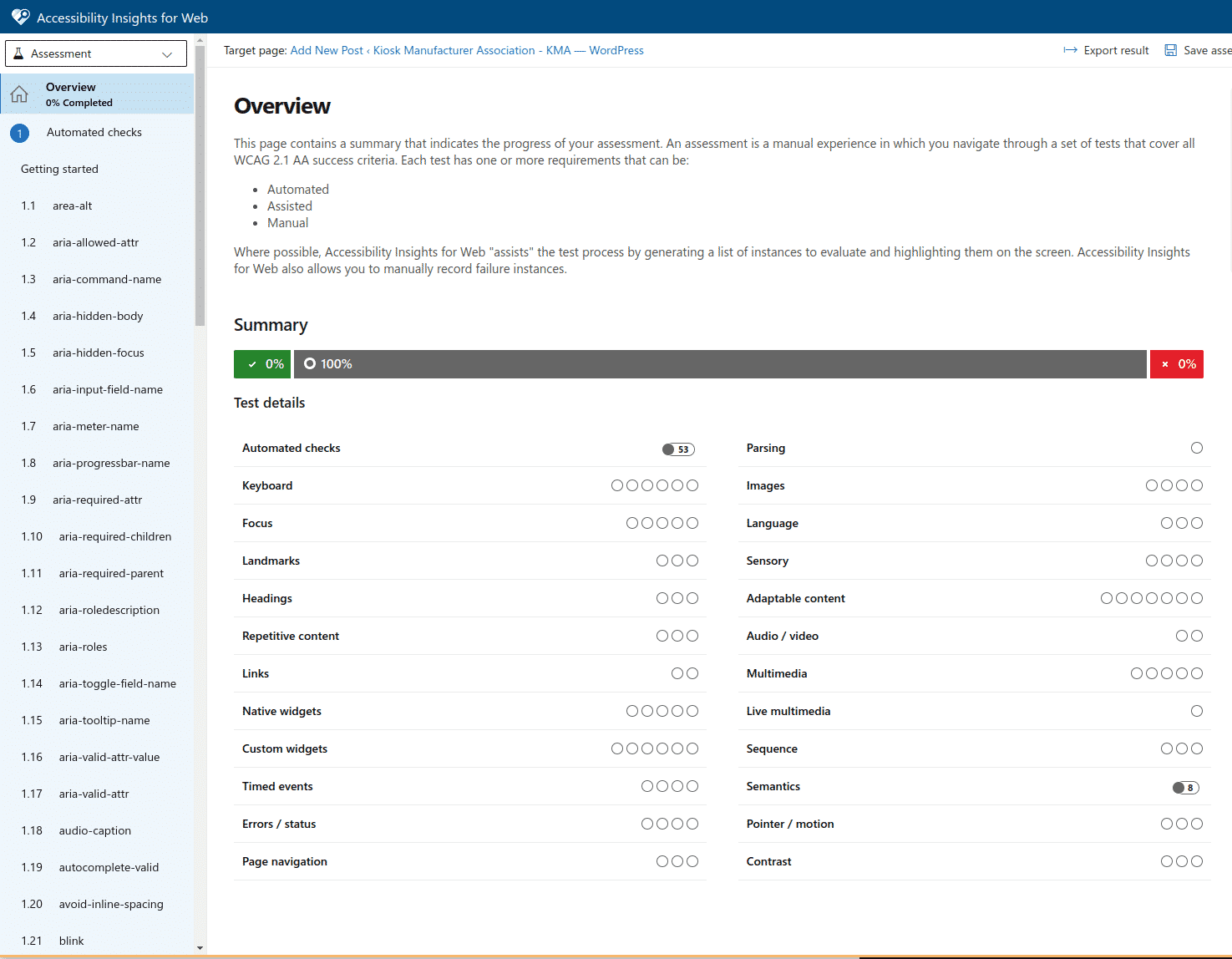
    • We like the new insights from Microsoft Edge browser — it has a fast check that catches stupid mistakes and then more in depth test
    • A great reference site and another testing tool is webaim
    • Don’t pay for a testing tool
web accessibility test by Edge

Click for full size — web accessibility test by Edge


Legal Actions regarding ADA

We maintain a chronology of regulatory “events” (aka lawyers in action) at kioskindustry Legal News. We often use the acronym “FOBS” which rhymes with sobs and stands for Fear of Being Sued. Going cheap not only costs more money, but it narrows your audience. The disabled community is 25 million or so and it is only increasing. Think of them as customers.  Japan does.. For reference, Japan is aging rapidly, those over 65 already constituted 27.7% of the total population in 2017. This figure is the highest in the world and is projected to grow continuously up to 38.4% in 2065.  These are trends that we will likely see in the U.S. and Europe for that matter.

Regulatory News – ADA POS, & EV Charging

ADA FAQ

Updated Regulatory Information for Kiosks, POS and EV Charging – June 2022

The big news is that the U.S. Access Board has announced its next session which include EV Charging Stations, Kiosks and POS. Not quite sure of the difference between information transaction machines and kiosks but we will find out.

  • It’s also very important (cannot be overstressed) that not only manufacturers but users need to comment.
  • Once it is closed for comments you cannot insert a single word. During the comment phase all comments are taken, recorded and considered.
  • For POS we think reach may be addressed as well as Audio

It is worth noting too that ANSI has taken a strong interest in EV Charging. The Kiosk Association is an Associate Partner sponsor of the ANSI Electric Vehicles Standards Panel and is signed up to participate on working group

In Brief

  • US Access Board Session EV Charging — EV Charging Stations. According to the Agenda, the Access Board will be issuing a Notice of Proposed Rulemaking (NPRM) in September 2022 to set standards for accessible EV charging stations with the intent that the DOJ will eventually incorporate those guidelines in the current ADA Standards for Accessible Design. The rulemaking responds to the Infrastructure Investment and Jobs Act’s allocation of $7.5 billion to construct a national network of 500,000 EV charging stations nationwide.
  • US Access Board Session Transaction Machines — Fixed Self-service Transaction Machines. With the proliferation of self-service machines at public accommodations in the past few years, it is no surprise that the Access Board will be working on standards for accessible self-service kiosks, information transaction machines, and point-of-sale devices. The Agenda states that an NPRM will be issued in August 2022. It is very important for manufacturers of these machines, as well as the businesses that use them (e.g. retailers, rental car companies, lodging facilities, health care providers, banks, parking facilities, restaurants) to file comments on the Access Board’s forthcoming proposed guidelines because, once finalized, they are not likely to change in DOJ’s rulemaking process to make them enforceable standards.
  • Maryland Launches Assistive Technology Loan Program — Assistive technology is any item, piece of equipment, software program, or product system that is used to increase, maintain, or improve the functional capabilities of persons with disabilities. Assistive technology allows individuals with disabilities to carry out activities of daily living (bathing, dressing, eating, etc.), participate in the workforce, communicate, learn, and enjoy recreational activities.
  • Has The Time Come Finally for Accessibility and Digital Menus For Restaurants? — That’s why we’re asking the question: should restaurant accessibility standards include digital menus?  Article reprinted from Keyser, a major provider of  displays and digital menu boards.
  • Comments by Seyfarth — While the rulemaking process can take years, we predict the DOJ will work hard to get all of these new standards finalized before the end of the Biden Administration because a regime change will most certainly halt all regulatory activity, yet again.
  • Disability Inclusion in the Workplace Interview — interview of CraigK
  • DOJ Goes All in on ADA is a Nondelegable Duty — In the Statement of Interest, the DOJ goes all in on the ADA being a nondelegable duty. That the ADA is a nondelegable duty should not surprise readers of this blog because we previously discussed that here, and I return to the concept frequently.
  • Canada CSA Group — we (KMA) submitted technology considerations for next CSA session.
  • Canada ADA groups — three groups in Canada have applied to join ADA Committee
  • EV Charging Expected Overall Regulations
    • guidance doc
    • EV charging stations will need to comply with ADA and Section 504 requirements and be accessible to and usable by individuals with disabilities, including those using wheelchairs or other assistive equipment. Key considerations include safety and ease of use. Specifically, designs for EV charging stations must ensure adequate space for exiting and entering the vehicle, unobstructed access to the EV charging stations, free movement around the EV charging stations and connection point on the vehicle, and clear paths and close proximity to any building entrances.
    • NEVI funds can be used to retrofit existing non-ADA compliant stations to ADA compliant
    • Revenue from retrofitted or new chargers (advertising?) will be deducted from funding received. The State DOT will likely have input on partnerships.
    • Title 3 will apply no doubt
    • 40% to disadvantage communities (underserved, underbanked)
    • Useful links for State DOT — For example, FHWA’s guide, Public Involvement Techniques for Transportation Decisionmaking, provides examples of public engagement best practices and illustrates how meaningful public engagement entails more than simply holding public events, but also incorporating public comments and feedback into decisionmaking. Additional suggested resources include:
    • • Public Involvement Techniques for Transportation Decisionmaking (FHWA) – Public Involvement
      Techniques – Publications – Public Involvement – Planning – FHWA (dot.gov)
      • Virtual Public Involvement (FHWA) – EDC-6: Virtual Public Involvement | Federal Highway
      Administration (dot.gov)
      • How to Engage Low-Literacy and Limited-English-Proficiency Populations in Transportation
      Decision Making (FHWA) – Low Limited – Publications – Planning – FHWA (dot.gov)
      • Every Place Counts Leadership Academy Transportation Toolkit (FHWA) – Every Place Counts
      Leadership Academy (transportation.gov)


Kiosk Association Restaurant Kiosks

Kiosk Association

Kiosk Association

From PRNewswire Kiosk Association Apr2021

DENVER, April 16, 2021 /PRNewswire/ — National Restaurant Association has launched Show To Go and the Kiosk Association is a participant. The online show runs through August 2021. We have eight showcases online: QSR Self-Order, Touchless Controls, Outdoor Menu Boards, ClearConnect full suite solution, Restaurant Kiosks, gigantic digital signage (LVCC), large digital signs and touchscreens. April 21 is a casual “Ask An Expert” web session for ADA and PCI, and there are Special Offers as well. For reference, we are also doing NRF Converge Retail in June which will be interesting.

Data Reports — this month is the lengthy 2021 Self-Service Market Research report [140 pgs], the NRA 2021 State of the Industry [26 pgs], and the NRN Top 200 report. Contact any of our Gold sponsors for a copy of any: OleaKioWarePyramid ComputerNanonationKIOSK Information SystemsKioskGroupVisperoZebraAUO22Miles, and LG Electronics Business Solutions, and Panasonic Restaurant Solutions.

ADA Accessibility News — New court decision on Winn-Dixie web accessibility + background on Coca-Cola drink station decision and case.

  • ADA Kiosk Lawsuits — Legal Judgement Reasons To Be Accessible
  • Web Accessibility Lawsuits – How to prevent and how to react. Winn-Dixie website verdict.

PCI and EMV — We’ve fielded several questions regarding PCI Compliance for CATs and kiosks so it seems a good time for us to provide some updated info. Thanks to Rob at UCP and Bruce with Ingenico.

We are also covering the benefits and drawbacks of using QR codes for payment (Ingenico blog series)

Latest Posts

  • Portable Pizzeria Powered by Robots
  • Ghost Kitchen Kiosks in Walmart – Cloud Kitchens rationale and logic
  • Interactive 50″ Drive-Thru Real Person On Video Inset Taking Order – Bite Ninja
  • Taco Bell Kiosk — Times Square Full Digital Location Review
  • New Member – SuzoHapp Global – Gaming, Amusement, and Sports Betting
  • PCI Kiosk Update – POS Credit Card Readers for Kiosks
  • Massive Digital Signage LED Wall Installation for LVCC
  • Digital Menu Boards — Panasonic ClearConnect™ Restaurant Solutions
  • Smart Locker System — GRUBBRR & Frank Mayer Smart Pickup Smart Curbside
  • ADA Webinar U.S. Access Board March 2021 Wrap – Kiosk Access
  • Wayfinder Kiosk – Improving the Visitor and Employee Experience
  • Restaurant Kiosk – National Restaurant Association Show To Go 2021
  • ADA Kiosk 2021 Update — Kiosk Lawsuits — Reasons To Be Accessible

Notable Links:

  • Updated McDonalds Menuboards Failures – Isotropic-like failures — sometimes it is as simple as NOT changing a filter

McDonalds News

  • Robotic Delivery by Chick-fil-A in California Being Tested
  • New article on “Fully Digital” Times Square Taco Bell – QSRMagazine
  • By this summer, only 150 McDonald’s will remain inside Walmart stores
  • H-E-B is partnering with Texas A&M University to provide grocery delivery to people who live on its main and West campuses in College Station, Texas.

Visit kiosk industryKMA.globalRetail AutomationDigital Business and Thinclient for more information.

This release was issued through Send2Press®, a unit of Neotrope®. For more information, visit Send2Press Newswire at https://www.Send2Press.com

SOURCE Kiosk Manufacturer Association

Kiosk Association and NRF 2021 Chapter One

Press Release PR Newswire Jan 08 


NRF 2021 Chapter One KIosk Trade Show

NRF 2021 Chapter One KIosk Trade Show

DENVERJan. 8, 2021 /PRNewswire/ — Visit NRF 2021 Chapter 1 next week and meet with Kiosk Association. Dates are January 12, 13, 14, 19, 21 and 22 beginning next week.  Our online page is https://virtualbigshow.nrf.com/company/kiosk-association-kma

Our portal page with helpful links, research, predictions, brochures and videos for NRF 2021 Chapter One is available here: https://kioskindustry.org/nrf-2021-chapter-one-kiosk-tradeshow-january/

If interested in attending the cost for retailers is $195. The Kiosk Association has a limited number of free Expo passes that are available. Contact Craig or one of our Gold Sponsors or members.

The Kiosk Association (KMA) is a global organization focused on improving self-service for customers and employees thru kiosks & digital signage. Our mission is to inform and educate. We provide:

Solutions

  • Retail kiosk solutions Cash2Card
  • Self-order stations (McDonalds e.g.)
  • Outdoor solutions for customer order including menuboards for drive-thru
  • Digital signage & wayfinding
  • Bill Payment & Financial Kiosks
  • Ticketing Kiosks
  • Employee Health Screening Kiosks or Temperature Kiosks
  • Software including Contactless, Touchless Kiosk, and AI

Regulatory Guidance
We help establish & communicate best practice regulatory guidelines for ADA and PCI. We work with U.S. Access Board and are a Participating Organization of PCI SSC. Other regulatory issues are UL, HIPAA, & DOT.

Research
The February 2021 research report (130 pages) is being released this month. Contact us at NRF2021 for report in its entirety.  Excerpt:  The U.S market for self-service kiosks was valued at $2.6 billion in 2019.

Questions – Contact Craig Keefner | craig@kma.global | 720.324.1837 m (text or call)

Gold Sponsors:  Olea Kiosks, Inc., KioWare, Frank Mayer and Associates, Inc., Nanonation, Pyramid, KIOSK Information Systems, KioskGroup, Vispero, Zebra, AUO Displays, 22 Miles & Honeywell.

About Kiosk Manufacturer Association:

Based in Westminster, Colorado, the Kiosk Association or KMA has served the unattended self-service kiosk market since 1995. The Kiosk Association leads the effort to optimize self-service engagements and outcomes using technology such as kiosks, digital signage and displays, service, monitoring, and touchscreens.

Regulatory issues PCI Compliance and EMV are the primary regulatory focus for the KMA along with ADA Accessibility. KMA is a Participating Organization with the PCI SSC. For ADA, the KMA meets annually with U.S. Access Board on accessibility standards for unattended. Additional market coverage includes digital signage, interactive digital, Point-of-Sale, Smart City, vending and robotics. See us on LinkedIn. KMA is available on https://kioskindustry.org and https://kma.global

LOGO: https://www.Send2Press.com/300dpi/20-0315s2p-kioskma-300dpi.jpg

This release was issued through Send2Press®, a unit of Neotrope®. For more information, visit Send2Press Newswire at https://www.Send2Press.com

SOURCE Kiosk Manufacturer Association